
Lesson Aim: To show how the Holy Spirit cooperated with our king to establish the kingdom in Christ, full grown, and able to reproduce.
Introduction
But I tell you this truth, it is to your advantage that I go away; for if I do not go away, the Helper shall not come to you; but if I go, I will send Him to you. And He, when He comes, will convict the world concerning sin, and righteousness, and judgment. ( John 16:7, 8)
Jesus made the foregoing statement to His disciples just before His death. In this lesson, we will study the person of divinity referred to by Jesus, the Holy Spirit. We will investigate His role as He works with Jesus Christ, our king to establish and maintain the goals of God, the Father, for mankind in His kingdom. We will appreciate how the strategies of our king required absolute coordination with the work of the Holy Spirit. In a wider study of God’s word concerning the Holy Spirit, you will notice that He is the third person in the Godhead sharing the same divine attributes with the Father and the Son. There is only one God, but He exists and reveals Himself in three “persons” (1 Cor. 8:6; 2 Cor. 13:14).
The first point of this four-point lesson will be a general introduction of the Holy Spirit. The second point will show the Holy Spirit’s involvement with the apostles as they were “baptized” with Him to evangelize the world. In the third point, we will see how the Holy Spirit imparted spiritual gifts to some church members to mature the local church. The fourth point will show how the Holy Spirit continues to cooperate with Jesus in the sanctification of His citizens to qualify us as children of God who will, one day, inherit His great kingdom.
Point 1: Introduction of the Holy Spirit
Lesson
In the beginning God created the heavens and earth…and the Spirit of God was moving over the surface of the waters. (Gen. 1:1, 2)
In the first chapter of Genesis, each day for six days, we see God calling into physical reality our present cosmos. The Hebrew word elohim has been translated God. Since it denotes plurality in number, it does not surprise us to hear God say, “Let Us make man in Our image” (Genesis 1:26). The plural pronouns “Us” and “Our” include God the Father, God the Spirit, and God the Son, Jesus Christ. Speaking of Jesus, the Apostle Paul says:
“For by Him all things were created, both in the heavens and on earth, visible and invisible, whether thrones or dominions or rulers or authorities — all things have been created by Him and for Him.” (Col. 1:16)
Job mentions the role of the Holy Spirit in creation: “The Spirit of God has made me, and the breath of the Almighty gives me life” (Job 33:4). Isaiah made a distinction between the Lord God and His Spirit in Isaiah 48:16.
The King James translators made use of the word “Godhead” to translate the Greek words theios in Acts 17:29, theiotes in Rom. 1:20 and theotes in Col. 2:9. The New American Standard translators chose the term “divine nature” for these Greek words. There are several scriptures in the New Testament that identify three separate persons who form the Godhead or Deity. See Matt. 28:19; Rom. 15:30; Mark 1:9-11; John 15:26; II Cor. 13:14; I Pet. 1:2. From a study of these scriptures and many others, we understand the Holy Spirit is a person just as the Father and Son. For instance, the Holy Spirit loves Christians and maintains fellowship with us (1 John 3:24).
If we were to attempt to assign a main role to the Holy Spirit throughout all the ages of mankind, it appears that He is an “informer of truth” to man. He brings instructions from God and gives us spiritual information. Peter said, “For no prophecy was ever made by an act of human will, but men moved by the Holy Spirit spoke from God” (II Pet. 1:21). However, this was not His only role. For example, He worked with Bezalel in craftsmanship (Ex. 35:30-31). The Holy Spirit has a complete understanding of the laws of nature. He is the worker of miracles. Miracles demand changes of natural laws.
The Holy Spirit changed the nature of conception when a virgin named Mary conceived Jesus. Jesus, the Christ, emptied Himself of the form of God and was made in the likeness of man (Matt. 1:18; Luke 1:35; Phil. 2:6-7). Although the Holy Spirit was instrumental in Mary’s conception of Jesus, we are not told of another encounter between Jesus and the Holy Spirit until 30 years later. This was when Jesus was baptized by John the Baptist (Luke 3:21-23). The birth of John the Baptist was a miracle in which the Holy Spirit was active. In fact, the Holy Spirit was with John even while he was in his mother’s womb (Luke 1:15).
The birth of Jesus and John the Baptist show the work of the Holy Spirit as He cooperated with the other persons of Deity to give us a divine king over the kingdom of God. At that time in history the man dimension of God’s kingdom was in sad disarray. The physical nation of Israel did not have a king from the seed of David. Rome ruled their nation. However, Jesus was soon to make Himself known as the Messiah through His own preaching and that of His forerunner, John the Baptist (Matt. 11:1-14).
The Holy Spirit had prepared John the Baptist well for his role as the “forerunner” of the king. John said, “I am not the Christ,” and again he said, “He must increase, but I must decrease” (John 3:28, 30). Jesus and John both preached the kingdom (Matt. 3:1-2; 4:17). John baptized in water, a baptism of repentance, but Jesus would baptize with the Holy Spirit and fire (Matt. 3:11). Those whom Jesus sent out preached the kingdom, exercised power over demons, and healed diseases. However, none of them were baptized with the Holy Spirit until after Jesus returned to heaven (Acts 1:5). We will discuss this special event in Part 2 of this lesson.
John the Baptist said, “For He whom God has sent speaks the words of God; for He gives the Spirit without measure” (John 3:34). It is significant to note that Jesus did no miracles until after the Holy Spirit was with Him “without measure.” Everything Jesus did after His baptism was done in relationship with the Holy Spirit.
Jesus was vindicated (justified, declared righteous and just) in the Spirit in I Tim. 3:16. The Hebrew writer said, “Who through the eternal Spirit offered Himself without blemish to God” (Heb. 9:14). The Holy Spirit was not only with Jesus in His death, He declared Jesus to be the Son of God by the resurrection of Jesus from the dead (Rom. 1:4). The Holy Spirit led Jesus into the wilderness for a forty day fast. At the end of this fast, Jesus was tempted by Satan. This is the first recording of Jesus directly rebuffing Satan but, happily, not the last (Luke 4:1-13). Jesus continually cast out demons by the power of the Holy Spirit during His ministry on earth (Matt. 12:28).
When the scribes accused Jesus of being possessed by Beelzebub He gave the following warning to them.
“Truly I say to you, all sins shall be forgiven the sons of men, and whatever blasphemies they utter; but whoever blasphemes against the Holy Spirit never has forgiveness, but is guilty of an eternal sin” – because they were saying, ‘He has an unclean spirit.’ (Mark 3:28-30)
No one should venture to attribute the works of the Holy Spirit to Satan or demons. The Holy Spirit’s work is to glorify Jesus. He (the Holy Spirt) will “take of Mine (Jesus), and shall disclose it to you” (John 16:14). If one rejects the ministry of the Holy Spirit to “disclose Jesus” to us, there is no “back-up” plan for salvation. For us today, the disclosure of Jesus by the ministry of the Holy Spirit in the completion of the inspired word of God is our only hope of knowing Jesus. As our relationship with Jesus must be established by faith, we must understand the vital nature of the word in the development of our faith.
So faith comes from hearing, and hearing by the word of Christ. Rom. (10:17-18)
Since the delivery of the inspired word (which is now complete) was one of the main ministries of the Holy Spirit, He will always work consistently with the word, never contradictory. Though not the same thing as the word, the Holy Spirit and the word are closely linked in scripture.
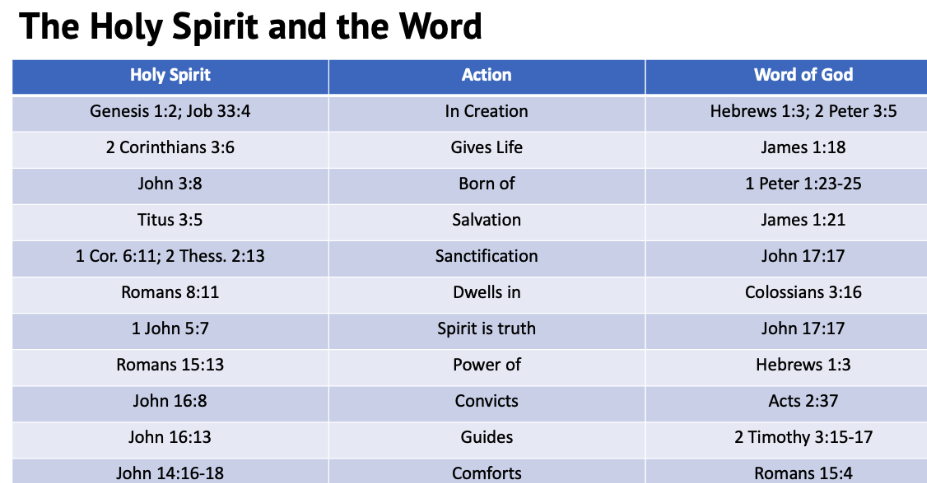
Jesus said the Spirit was upon Him just as Isaiah had prophesied. He read Isaiah 61:1 in His hometown synagogue and then said, “Today this scripture has been fulfilled in your hearing” (Luke 4:16-22). After Jesus returned to heaven and baptized the apostles with the Holy Spirit, Peter said to the household of Cornelius, “You know of Jesus of Nazareth, how God anointed Him with the Holy Spirit and with power, and how He went about doing good, and healing all who were oppressed by the devil; for God was with Him” (Acts 10:38).
In summary we can say the Holy Spirit, as a person of Deity and in cooperation with the other two Persons of the Godhead, participated in the creation of this world. The Holy Spirit inspired men to speak the word of God and even inspired their ability with certain skills including leadership roles. Furthermore, the Holy Spirit helped in the transition of the Son of God to the son of man. He continued to assist Jesus to establish His reign in the kingdom of Christ. The Holy Spirit assisted Jesus with His preaching of the word of God, in casting out demons and in the healing of sick people. He was with Him in His physical death and resurrection. He continued to serve Jesus as king as Jesus took His seat in heaven at the right hand of the Father (Acts 7:56). Jesus had the assistance of the Spirit “without measure” while upon earth (John 3:34). Just as He helped to “finish” the creation by moving over the surface of the waters, so the Holy Spirit in the Christian Era helps to “finish” the work of Jesus. In the remaining segments of this lesson, we will see how some received the baptismal measure of the Holy Spirit, how others received gifts via the Holy Spirit, and how all faithful Christians enjoy His fellowship.
Questions for Discussion
- After whose direct assistance was the man-dimension of God’s kingdom – with Jesus as king – established after Jesus returned to heaven?
- What is the significance of God’s use of plural pronouns in Genesis 1:26?
- Who are the three persons identified as the Godhead or Deity? List one scripture that includes the three.
- What appears to be the main role of the Holy Spirit in relation to mankind before the Bible was completed?
- List some other roles of the Holy Spirit.
- In what way did the Holy Spirit prepare John the Baptist well for his ministry?
- What was the degree of cooperation between Jesus and the Holy Spirit? Please give one scripture for your answer.
- List some of the traumatic periods of Jesus’ life in which the Holy Spirit shared.
- What did the scribes say that prompted Jesus’ warning about a sin God will not forgive?
Point 2: The Baptism with the Holy Spirit
Introduction
Therefore having been exalted to the right hand of God, and having received from the Father the promise of the Holy Spirit, He has poured forth this which you both see and hear. (Acts 2:33)
John the Baptist said Jesus would baptize with the Holy Spirit (Mark 1:8). This did not happen until after Jesus took His seat at the right hand of God as king over God’s kingdom. During the forty days Jesus spent on earth after His resurrection, He told the apostles, “You shall be baptized with the Holy Spirit not many days from now” (Acts 1:5). The “baptismal measure” of the Holy Spirit that the apostles received came on the Day of Pentecost (Acts 2:1-4). Of course, in using the terminology of “measure”, we refer to the “delegated authority or power” of the Holy Spirit recognizing that the Spirit is Person not an impersonal substance.
The first Gentile converts were baptized with the Holy Spirit while Peter was preaching to the house of Cornelius. Both the events at Pentecost and at Cornelius’ house had great similarities. For when relating this incident later, Peter said, “The Holy Spirit fell upon them, just as He did upon us at the beginning.” Since there appears to be a vast difference in the powers Cornelius and his household were given and those the apostles were given at Pentecost, we might conclude that only the apostles had the baptismal measure of the Holy Spirit. However, the Gentiles on this occasion did receive a special sign, evidently to signal to the apostles that the Gentiles have now been brought into the New Covenant. This was a significant and difficult reality for even the apostles to comprehend at first. Thus, the entry of the Jews to the New Covenant Kingdom of Christ happened on Pentecost. Entry for the Gentiles happened at the house of Cornelius.
Many confuse the baptism for the remission of sins with the baptism with the Holy Spirit. They are not the same. The following chart of comparison may be helpful.
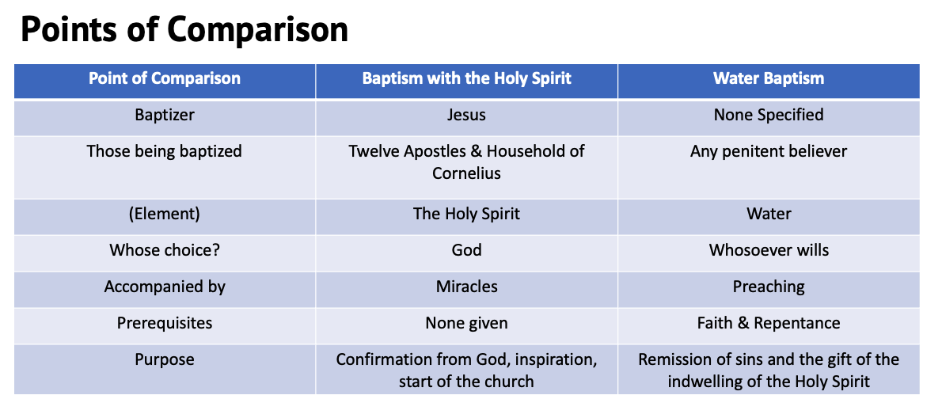
The baptism with the Holy Spirit was prophesied to be the inauguration of the New Covenant Era. Peter underscored this in reference to the baptism with the Holy Spirit in his quoting of Joel’s prophecy in Acts 2:16-21 (Joel 2:28-32). Other prophecies underscore the establishment of the New Covenant at this same time.
“And a Redeemer will come to Zion, And to those who turn from transgression in Jacob,” declares the Lord. “And as for Me, this is My covenant with them,” says the Lord: “My Spirit which is upon you, and My words which I have put in your mouth, shall not depart from your mouth, nor from the mouth of your offspring, nor from the mouth of your offspring’s offspring,” says the Lord, “from now and forever.” (Isa. 59:20-21)
“Then I will sprinkle clean water on you, and you will be clean; I will cleanse you from all your filthiness and from all your idols. Moreover, I will give you a new heart and put a new spirit within you; and I will remove the heart of stone from your flesh and give you a heart of flesh. I will put My Spirit within you and cause you to walk in My statutes, and you will be careful to observe My ordinances. You will live in the land that I gave to your forefathers; so you will be My people, and I will be your God.” (Ezek. 36:25-28)
“And My servant David will be king over them, and they will all have one shepherd; and they will walk in My ordinances, and keep My statutes, and observe them. And they shall live on the land that I gave to Jacob My servant, in which your fathers lived; and they will live on it, they, and their sons, and their sons’ sons, forever; and David My servant shall be their prince forever. And I will make a covenant of peace with them; it will be an everlasting covenant with them. And I will place them and multiply them, and will set My sanctuary in their midst forever. My dwelling place also will be with them; and I will be their God, and they will be My people.” (Ezek. 37:26-27)
Brother James Burton Coffman wrote concerning Ezekiel 36:25-28: “Significantly, none of these (blessings) was available under the Law of Moses. Only under the gracious terms of the New Covenant has there ever been available to mortal men such blessings as these. There was no forgiveness of sins under Moses; there was no Holy Spirit within all the people; there was no regeneration.” Concerning Ezekiel 37:24-28, Coffman continues: “This can be no other than Christ, of whom it was said when he was brought into the world, ‘He shall reign over the house of Jacob forever’ (Luke 1:33)… The Messiah is here called ‘David,’ because he shall be of the seed of David… We have already noted in earlier chapters that this ‘covenant of peace,’ “Is none other than the New Covenant of Jer 31:31-34; it will be an everlasting covenant as well. It will not be founded on national or racial considerations of any kind whatever.” (from Coffman’s Bible Commentary, Copyright © 1971-1993)
We find recorded in the book of Acts that Jesus enjoyed a fantastic and successful evangelism program after He returned to heaven and baptized the apostles with the Holy Spirit. First, three thousand Jews or Jewish proselytes were baptized on Pentecost (Acts 2:41). Then shortly thereafter the number rose to five thousand men (Acts 4:4). After this, multitudes of men and women were added (Acts 5:14). Then Luke, the author of Acts, tells us conversions were increasing in numbers including large numbers of priests (Acts 6:1, 7). In Samaria, both men and women were baptized after hearing the message of the kingdom and the name of Jesus Christ (Acts 8:12). In Lydda and Sharon all turned to the Lord while the numbers increased in Judea, Galilee, and Samaria (Acts 9:31, 35). Even the Gentiles were offered repentance that leads to life (Acts 10:48). The success story continued as large numbers were converted at Antioch and in parts of Asia (Acts 11:21; 14:21).
What made Jesus’ evangelism program so successful at this time? Jesus told the apostles to wait in Jerusalem until they were “clothed with power from on high”, and so they did; and, they were (Luke 24:49). For the first time, they fully understood the kingdom of God and how they were to be children in God’s heavenly spiritual kingdom. They understood Jesus in His spiritual role as king and high priest (Heb. 5:8-10; 7:26-27; 8:1). Although Jesus had explained these things to them carefully, it took the baptismal measure of the Holy Spirit to open their minds miraculously so they could understand what they had heard.
This new understanding became the basis for their faith; consequently, they took courage. As was suggested in a previous lesson, we see a great difference in Peter after he was immersed in the Holy Spirit. Compare Peter’s behavior the morning they arrested Jesus versus his boldness after Pentecost when he came before the same people with confidence. Peter was not afraid of physical death, because he had come to understand the resurrection (John 18:15-27; Acts 4:19-20).
Now as they observed the confidence of Peter and John, and understood that they were uneducated and untrained men, they were marvelling, and began to recognize them as having been with Jesus. (Acts 4:13)
Jesus had told His apostles not to worry about encounters like the foregoing. He said, “The Holy Spirit will teach you in that very hour what you ought to say” (Luke 12:12). Also, He said, “He will teach you all things and bring to your remembrance all that I said to you” (John 14:26). And again, He said, “He will bear witness of Me” (John 15:26). Before the apostles enjoyed the help of the Holy Spirit, Jesus confused the apostles when He said, “A little while, and you will no longer behold Me; and again a little while, you will see Me. And so they were saying, “What is this that He says, ‘A little while?’ We do not know what He is talking about’” (John 16:16, 18). However, after they were clothed with the Holy Spirit, they could explain all things concerning Jesus and His kingdom.
It is easy to lose sight of Jesus our king as we become engrossed in the work of the Holy Spirit and the apostles in Acts. We must remember Jesus was the source of all the directives the apostles received via the Holy Spirit.
But when He, the Spirit of truth, comes, He will guide you into all the truth; for He will not speak on His own initiative, but whatever He hears, He will speak; and He will disclose to you what is to come. (John 16:13)
We can be sure that what Jesus wanted implemented in the world is exactly what the Holy Spirit directed. For instance, Jesus said, “And He (the Holy Spirit), when He comes, will convict the world concerning sin, and righteousness, and judgment” (John 16:8). The gospel of the kingdom is the powerful message that convicts the world, but it must be preached in an understandable way. The apostles obtained the power to understand when they were clothed with “power from on high.” They also had some other powers supplied by the Holy Spirit to aid in their work.
On the day of Pentecost, the presence of the Spirit was accompanied by a sound like a rushing mighty wind. This helped draw an audience. Another power that became a useful part of the apostles’ ministry was their ability to speak in tongues (Acts 2:1-6). This relieved the early preachers and teachers of the necessity to spend time in a language school. Their being able to speak in tongues also served as a sign to non-believers. This gift made it easier for the public to believe the message was authorized by God (I Cor. 14:22).
These Spirit immersed apostles were able to heal some sick people and to make some people sick who were well. For instance, Peter healed a man who had been lame from his birth, and Paul struck Elymas blind (Acts 3:6; 13:9-11). Handkerchiefs and aprons were carried from Paul to some people who were sick, and other people were laid on Peter’s path with the hope that his shadow would pass over them and that they would be healed (Acts 5:16-17; 19:11-12). They even had a cure for those who went to sleep during the sermon and when members of the church lied about their contribution. Paul revived Eutychus when he went to sleep and fell out of the third-floor window during his sermon. Ananias and Sapphira died when they lied about their offering to the Holy Spirit in the presence of Peter (Acts 5:1-10; 20:9). The foregoing are things the apostles were able to do after they were baptized with the Holy Spirit.
The Apostle Paul had the same powers as the other apostles (Acts 1:21, 22; I Cor. 9:1). Unique to the role of being one of Christ’s Apostles was the ability to pass on to other Christians temporary miraculous gifts of the Spirit. This enabled others to perform miracles. We can make this deduction because Peter and John travelled from Jerusalem to Samaria to lay their hands on certain believers so they could receive the Holy Spirit in such a way as to perform miracles (Acts 8:14-15).
An overall study of Acts and the epistles will show the apostles had authority over the churches for a while. Paul explained this in II Cor. 13:1, 2 and I Thess. 2:6. With the Holy Spirit’s power working through the apostles, Jesus Christ, our king, was able to win many citizens for His kingdom in the first century. After successful evangelism in a town, the apostles had the power to pass on gifts from the Holy Spirit to certain church members for the maturing of the church (I Cor. 12:27, 28; II Cor. 12:12). This authority and these powers were the result of them having been baptized with the Holy Spirit.
If the first century mission campaign was so successful then we might ask, why did our king remove the baptismal power of the Holy Spirit from the leaders of the church? Wouldn’t it be useful to have those great powers of the Holy Spirit to fulfil our ministry, today? The ability and power of preaching and teaching with a full understanding of the kingdom of God, speaking the language of different audiences, healing the sick, raising the dead striking blind those who hinder the hearers, casting out evil spirits, enjoying immunity from poisonous snakes and insect bites would surely be a great asset for establishing churches for God, today!
According to human wisdom, it might seem wise for Jesus to have continued with this arrangement. Evidently, many charismatic religious leaders claim He has not changed His original program. The world is still waiting for them to prove their point. To the rest of us, it appears the Holy Spirit cooperated with Jesus in this powerful manner until the church was established – full grown and able to reproduce herself with the word of God. Our king did not want this type of campaign after certain goals were accomplished. We must come to this conclusion because we cannot find anyone who is able to perform the variety of miracles on the level of completeness the men did who were baptized with the Holy Spirit. Furthermore, the apostle Paul tells us that these temporary miraculous gifts would cease (1 Cor. 13:8-13).
Jesus now wants people to be converted to the kingdom based upon the power of the word, and without the excitement and the intimidation of the miracles. We know our Lord’s church is unique, a church that functions as the body of Christ, a church with a clear understanding of the kingdom, a church whose leadership consists of successful fathers, a church whose members have personalities and characters like Jesus while having the faith of Abraham. This unique church should be able to convict the world of sin, righteousness, and judgment without the performance of miracles. This is consistent with how each of the major eras of history worked: begun by incredible miracles, but continued by the Word of God. This was true of the first era of history with the creation, true of the second with Moses, and true of the third with Jesus. Jesus established His kingdom in the first century with the cooperation of the Holy Spirit in miraculous ways because of the baptism of the Apostles with the Holy Spirit. These recorded miracles continue to establish our faith, even now.
Questions for Discussion
- Who was the first person to speak of the baptism of the Holy Spirit in the New Testament?
- When did the first baptism of the Holy Spirit happen?
- What incident reminded Peter of Jesus’ statement about the baptism of the Holy Spirit?
- Name the goal that the Holy Spirit helped Jesus accomplish?
- Describe the success of the evangelism program Jesus implemented with the help of the Holy Spirit?
- What were some of the immediate powers the apostles gained after they were baptized with the Holy Spirit?
- Describe the change in Peter’s behavior after he was baptized with the Holy Spirit?
- Who aided the apostles in preparing their lessons?
- Why is it easy to lose sight of Jesus as king in a study of the book of Acts?
- Of what did Jesus want to convict the world?
- List all of the powers listed in this lesson that the apostles gained as a result of the baptism of the Holy Spirit?
- How much power did the Apostle Paul have?
- Why might we conclude: only the apostles had the power to pass on to other Christians certain gifts of the Holy Spirit?
- Why do you think Jesus stopped arranging for the baptismal measure of the Holy Spirit?
- Describe the church that will be able to convict the world of sin, righteousness, and judgment?
Point 3: Gifts of the Spirit
Lesson
And God has appointed in the church, first apostles, second prophets, third teachers, then miracles, then gifts of healings, helps, administrations, various kinds of tongues. ( I Cor. 12:28)
The aim of Jesus Christ is to have “called out” groups of people, or churches, all over the world as citizens of His kingdom. He did not want Jerusalem, Antioch or Rome to be the headquarters. Heaven is the headquarters, and Jesus is the only head (Eph. 4:15). He wanted a church functioning as a family under elders who feed the church on His word (Acts 14:23; 20:32). However, to get the necessary evangelism underway and to establish churches throughout the world in one generation, the Apostles were baptized with the Holy Spirit. The Apostle Paul claimed the whole world heard the gospel by the time he was imprisoned in Rome (Col. 1:23).
Wherever the evangelism programs were successful, a church was established. If an evangelist like Paul had stayed with a single church for a long period of time, it would have stopped his world-wide evangelism thrust. On the other hand, if he had left the new church prematurely, they would have had no teachers qualified to mature the church. Jesus solved the problem in a very unique way. Along with permanent roles and spiritual talents, He gave some of the members of the local church temporary miraculous spiritual gifts.
And He gave some as apostles, and some as prophets, and some as evangelists, and some as pastors and teachers, for the equipping of the saints for the work of service, to the building up of the body of Christ. (Eph. 4:11-12)
This was another way the Holy Spirit cooperated with Jesus to attain His goals for God’s kingdom in the first century (I Cor. 12:11). Christians endowed with these temporary miraculous spiritual gifts worked as evangelists and teachers to develop the local church. For instance, Stephen and Philip were evangelists (Acts 6:8; 7:59; 8:26, 39). Agabus prophesied of coming events (Acts 11:28; 21:10, 11). Silas, Titus and Timothy did most of their Spirit “gifted work” under the direction of Paul as he functioned in his apostolic calling (Acts 17:15; II Cor. 8:23; Phil. 2:19; Tit. 1:5). Still other Christians who had these miraculous spiritual gifts worked in the local congregations to build up the church.
Some of the Corinthian church members who had these gifts had a jealousy problem. This was the occasion for Paul’s dissertation on the subject of spiritual gifts and their uses in a local church (I Cor. 12:1-11). He mentioned nine gifts. All were very practical for the operation of a local congregation in the early years of the beginning of the church, a church that did not yet have the Bible as we have it today. Any one of the apostles who had been baptized with the Holy Spirit probably had all nine of these gifts as they were delegated both the task and the authority to establish the church of Christ (Matt. 16:19).
Jesus did not want these new churches to be misled by ignorant Christians or be derailed by the workers of Satan. Therefore, He gave some members a “word of wisdom”. Also, He gave the word of knowledge either to the same person or to some of the other members. Other miraculous gifts the local church members received were spiritual gifts of faith, healing, effecting of miracles, prophecy, and the distinguishing of spirits. Some Christians had the gift of speaking in tongues. A different member had the gift to interpret these foreign languages. All of these particular gifts were miraculous and temporary.
These gifts gave the churches a clear message of God’s kingdom and the way Jesus wanted them to function. This equipped them, very quickly, to work in His evangelism program. For instance, some members had the gift of faith to evangelize in dynamic ways. The gifts of healing and the power to perform miracles were useful to draw an audience to hear the gospel. These miracles would assure the hearers the message was authentic. Of course, they also served to relieve the afflicted.
The gift of prophecy was for edification, exhortation and consolation of the churches (I Cor. 14:3-4). The tongues were a sign to the unbelievers, but they also served to break down the linguistic barriers for teaching. As Paul commanded, there had to be an interpreter for those present who did not speak this particular language. The spiritual gift of interpretation of tongues was one of the gifts available to members of the local church for the common good. The Lord gave the churches a protection system against those who might be pretenders. Consequently, some members were given the power to “distinguish the spirits”. John said they could test the spirits (I John 4:1).
Therefore I make known to you, that no one speaking by the Spirit of God says, ‘Jesus is accursed’; and no one can say, ‘Jesus is Lord,’ except by the Holy Spirit. (I Cor. 12:3)
Concerning non-miraculous permanent talents, some were already equipped to function in the type of government Jesus had in mind for His church. Successful fathers who had wisdom, knowledge, and faith were the type of overseers, or elders, Jesus wanted to feed and superintend His church. Though the Holy Spirit provided temporary miraculous gifts to some of these men in the early years of the first century, these roles of leadership quickly transitioned to non-miraculous means. Men in the churches who desired to take the responsibility of serving in leadership of their respective congregations would use their “natural” spiritual talents for serving as both elders and deacons (1 Tim. 3:1-13. These leaders would have been mature in age and the head of godly homes.
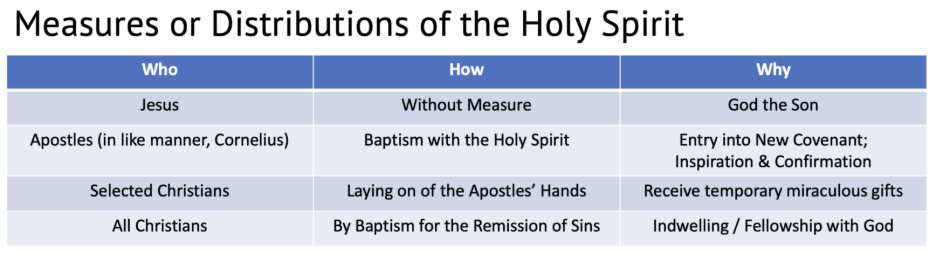
We have seen in Part 2 of this lesson how the Holy Spirit worked in a powerful way to evangelize the world through the ministry of the Apostles. Similarly, in this lesson we have understood how He worked with the churches to give them protection against being, as Paul said, “carried about by every wind of doctrine, by the trickery of men, by craftiness in deceitful scheming; but speaking the truth in love” (Eph. 4:13-14). The local church was led to maturity in the first century by these wonderful powers working through the members according to the will of the Holy Spirit. However, Paul suggested there was a more excellent way (I Cor. 12:31) that is permanent. Today, we have all of the information needed to serve Jesus as His church and to mature in love, the more excellent way. We have all three persons of Deity working with us (II Cor. 13:14). The Holy Spirit continues to lead through the word and the strengthening of Christians by indwelling or fellowshipping us (I Cor. 6:19; Eph. 3:16). We will study more about the Holy Spirit’s part in sanctification in Part 4 of this lesson.
Questions for Discussion
- Explain why the church, as it functioned in the book of Acts, had to mature into what Jesus wants for today.
- What happens when evangelism is successful?
- What would have happened in the middle of the first century if the evangelists had immediately left the church they established? What would have happened if they had stayed in the new church for too long of a period?
- How did Jesus solve the problems in question number three?
- How was the work of Timothy and Titus different from an evangelist today?
- What was the occasion for Paul’s dissertation to the Corinthians on spiritual gifts?
- List all of the spiritual gifts listed in the twelfth chapter of I Corinthians.
- Name the gifts that were useful for evangelism. List the gifts given to help mature the local churches.
- What does it mean to speak in tongues?
- How did Jesus protect the church against unscrupulous men who made false claims about spiritual gifts?
- What did the apostle Paul mean when he said, “…and I show you a still more excellent way?” (I Cor. 12:31).
Point 4: The Holy Spirit’s Work in Sanctification
Introduction
We have seen how the Holy Spirit worked with Jesus Christ, our king, to order His kingdom in the first century. At this point in history, the “physical nation of Israel” was no more important to God’s purposes than any other nation (Rom. 11:1, 23). “Spiritual Israel”, or the spiritual children of Abraham, had combined the faithful of Israel with those who would choose faith among the Gentile nations. This new kingdom would now be known as the Kingdom of Christ, the church of Christ. As the first century A.D. came to a close, congregations of God’s people were functioning all over the world with both Jew and Gentile members (Eph. 2:13-18; James 1:1). Some of the apostles were already dead and if the others were still alive, they were very old (Acts 12:2; II Tim. 4:6). We must assume they – through the Holy Spirit – had accomplished their special roles in our king’s purposes in the establishment of His church.
Jesus still has the same spiritual purposes for His church today; however, He has a different staff and another way for expediting His plans. The administrative staff no longer includes the apostles and prophets, but it does still include the Holy Spirit. While the apostles and other divinely inspired men were alive, the Holy Spirit used some of them to write down our Lord’s instructions, completing the Bible. These scriptures are the guide for Jesus’ subjects as the baptism of the Holy Spirit and the temporary miraculous spiritual gifts were no longer available to members of the church (1 Cor. 12:28-31; II Tim. 3:16, 17; II Pet. 1:20, 21).
The following is the work performed by miracle-gifted men and women in the first century. The book of Acts gives ample evidence of this prophetic passage in the Gospels having been fulfilled for the purpose of the establishment of Jesus’ church.
And these signs will accompany those who have believed: in My name they will cast out demons, they will speak with new tongues; they will pick up serpents, and if they drink any deadly poison, it shall not hurt them; they will lay hands on the sick, and they will recover. (Mark 16:17-18)
Paul spoke of the end of these powers, “For we know in part, and we prophesy in part; but when the perfect comes, the partial will be done away” (I Cor. 13:9, 10). In the first century each teacher and preacher who received their message by the direct power of the Holy Spirit gave a partial message at each presentation. In these last days of the man dimension of God’s kingdom on earth, we have the complete message about God’s final plan to accomplish His ultimate purposes. This message, which produces a Christian’s faith, was once and for all delivered before the end of the first century (Jude 3). They had the partial, but we have the perfect because it is complete (Eph. 1:10).
We must reject any prophet who says he has a message from God that contradicts what we have preserved in the Bible … or is an addition to what we have in the Bible (Gal. 1:6-12). The churches today have all of the information the churches of the first century received through those people who were guided by the Holy Spirit. We know how to function and what to preach and teach on all subjects pertaining to the Lord’s purposes for eternal life as children in His kingdom. The providential care and wisdom of God is still available to those of us who ask through faith and according to His will (Jas. 1:5-6).
Providence is the activity of God as accomplished through law as opposed to miracle. Miracle operates independent of law. In “providence”, God manipulates his own laws for the accomplishment of his ultimate purpose. In this process, God respects man’s free will – a facet of our having been made in God’s image. God never overpowers our “responsibility of choice”, our “free moral agency”, in the use of providential activity. The Bible clearly affirms divine activity via “providence”. The Apostle Paul, writing from Rome to the brethren at Philippi, said that the things which had happened to him “have turned out for the greater progress of the gospel” (Phil. 1:12). We may not know how God is working providentially on our behalf, but we can always trust that He is.
God is still interested in us, and the Holy Spirit has not yet finished His work in cooperation with Jesus’ reign. We know God responds to our prayers for the sick and other situations requiring His help. But there is a difference between the way God intervenes today and the way He worked through those with miraculous spiritual gifts (Jas. 5:13-16). Today, the power belongs to God to heal in answer to our prayers. The temporary miraculous spiritual gifts of the first century gave certain Christians the power to heal in the name of Jesus Christ. The recording of these miracles in the Bible is given to us for our faith development; they are sufficient in this regard. For Christians today, the Holy Spirit has a role in sanctification, and this is our subject in the final part of our study of His work.
Lesson
The goal of our Lord Jesus Christ is to conform each one of His citizens to His own image and present us all to God, the Father, as His children (Gal. 4:19; Col. 1:27). Our Lord’s strategy to accomplish His goal is to have the Holy Spirit work with each of us in our sanctification. Peter declares sanctification to be the Holy Spirit’s work in the following scripture.
According to the foreknowledge of God the Father, by the sanctifying work of the Spirit, that you may obey Jesus Christ and be sprinkled with His blood: May grace and peace be yours in fullest measure. (I Peter 1:2)
The Holy Spirit’s fellowship was one of the blessings resulting from the promise to Abraham for the Gentiles (Gal. 3:14). In fact, the promise of the Holy Spirit is for every obedient believer in Jesus Christ (Acts 2:39; 5:32). Faithful Christians depend upon the Father for the Spirit’s fellowship (Luke 11:13; II Cor. 13:14; I Thess. 4:8). The purpose of the Holy Spirit’s work in sanctification is to help Christians gain spiritual strength (Eph. 3:16). Jesus said, “If any man is thirsty, let him come to me to drink.” And then He said:
He who believes in Me, as the Scripture said, “From his innermost being shall flow rivers of living water.” But this He spoke of the Spirit, whom those who believed in Him were to receive; for the Spirit was not yet given, because Jesus was not yet glorified. (John 7:38-39)
The last days, or the Christian age, are known as the period of the ministry of the Spirit. He is now serving Christians in a more personal way than He served God’s people in any other age (II Cor. 3:8). It is by His fellowship and word that Christians know the Father and Son have made their abode with us (John 14:23; I John 3:24). This all began after Jesus was glorified on His throne.
The Holy Spirit ministers to us the words of life that He has written down for us in the divinely inspired scriptures (II Cor. 3:1-3). A part of God’s new covenant is that He will write His laws on our hearts and minds (Heb. 10:16-17). The Holy Spirit nurtures this life by leading us in a plan to implant this perfect law, the law of liberty, on the character of our inner man. This creates the new “self” as we are transformed into the image of Christ. Consider the following scriptures.
Who also made us adequate as servants of the new covenant, not of the letter, but of the Spirit; for the letter kills, but the Spirit gives life. (II Cor. 3:6)
Therefore putting aside all filthiness and all that remains of wickedness, in humility receive the word implanted, which is able to save your souls. (Jas. 1:21)
Therefore we do not lose heart, but though our outer man is decaying, yet our inner man is being renewed day by day. (II Cor. 4:16)
And put on the new self, which in the likeness of God has been created in righteousness and holiness of the truth. (Eph. 4:24)
The fruit of the Holy Spirit’s work in Christians’ lives will be manifested by the qualities listed in the following scripture.
But the fruit of the Spirit is love, joy, peace, patience, kindness, goodness, faithfulness, gentleness, self-control; against such things there is no law. (Gal. 5:22-23)
The Christians’ part in the ministry of the Spirit is to accept the new covenant, let Jesus cleanse us in His blood and walk with the Spirit by letting Him lead us in the spiritual life (Rom. 8:5-8). It is the only direction in which He will lead us, according to Paul in his letter to the Galatians.
But I say, walk by the Spirit, and you will not carry out the desire of the flesh. For the flesh sets its desire against the Spirit, and the Spirit against the flesh; for these are in opposition to one another, so that you may not do the things that you please. (Gal. 5:16-17)
This walk takes the exact steps John had in mind when he said, “The one who says he abides in Him (Jesus) ought himself to walk in the same manner as He walked” (I John 2:6). The tool the Holy Spirit uses to lead and communicate with Christians is the word of God. He sanctifies us in the truth He revealed by inspired Christians in the first century (John 17:17). However, the Holy Spirit’s fellowship, itself, is transformative in His work of our sanctification in these last days. He personally dwells with each Christian in order to strengthen our inner man, so that we, not He, can put to death the deeds of our flesh. Consider the following:
Or do you not know that your body is a temple of the Holy Spirit who is in you, whom you have from God, and that you are not your own? (I Cor. 6:19)
That He would grant you, according to the riches of His glory, to be strengthened with power through His Spirit in the inner man… (Eph. 3:16)
So then, brethren, we are under obligation, not to the flesh, to live according to the flesh – for if you are living according to the flesh, you must die; but if by the Spirit you are putting to death the deeds of the body, you will live. (Rom. 8:12, 13)
It is believed by some that the Holy Spirit does all of His sanctifying work through the word, alone. And whereas the word plays a huge role in this, Paul said in the foregoing scripture that the Holy Spirit’s fellowship with us is – in and of itself – transformative in our sanctification. The following scripture reveals a function of the Holy Spirit today that would be impossible for Him to accomplish through the word, alone. Today, He intercedes in our prayers to God. The Holy Spirit can help Christians’ weak prayer lives through His teachings about prayer in the Bible, but He cannot intercede for us through the word.
And in the same way the Spirit also helps our weakness; for we do not know how to pray as we should, but the Spirit Himself intercedes for us with groanings too deep for words; and He who searches the hearts knows what the mind of the Spirit is, because He intercedes for the saints according to the will of God. (Rom. 8:26, 27)
Granted, the Holy Spirit does not need to indwell to intercede, but we know He does indwell because of the inspired word that He gave us. “By this we know that we abide in Him and He in us, because He has given us of His Spirit.” (1 John 4:13). This “abiding” or “indwelling” is personal, but it is not physical. It concerns our bodies in that our spirit is connected to our bodies as long as we are alive. But the indwelling is by nature a spiritual fellowship that is possible because of two things. One, Jesus’ blood has removed my sin. Now, God can have spiritual fellowship with me, personally. Two, God the Holy Spirit has the same innate characteristic of being omni-present as does God the Father and God the Son. Thus, He can “indwell” each Christian on earth at the same time. In fact, Paul also speaks of His indwelling the body of the church. Though the individual Christian shares this same reality (1 Cor. 6:19), in this passage, the temple has reference to the body of Christians, the church.
Do you not know that you are a temple of God, and that the Spirit of God dwells in you? If any man destroys the temple of God, God will destroy him, for the temple of God is holy, and that is what you are. (1 Cor. 3:16-17)
Some have questioned whether or not the indwelling of the Holy Spirit would be the same thing as “possession” or even the “incarnation”, thus making an indwelt Christian devoid of free moral agency or into deity, respectively. Of course, the indwelling of the Holy Spirit has nothing to do with possession as demon possession violated the will of man. The indwelling only happens when we are “willing to do His will” (John 7:17), the will of the Father. As for the incarnation, only One has been incarnate, the Lord Jesus Christ. This was not Jesus indwelling human flesh; rather, it was Deity being clothed in human flesh.
The Holy Spirit strengthens our inner man through the word, but He also indwells us in order to strengthen us. Our inner man’s personality and character can be strengthened as a result of the Holy Spirit helping us in the following ways: in our communication with our Father, in our identification as sons of our Father, in order to have a healthy view of our resurrection and our inheritance, all while enjoying personal fellowship with Him.
Let us first consider how the Holy Spirit helps us in our communication. Our communication with God may be taken for granted, and it can be; however, we may be able to communicate in some cases only because the Holy Spirit intercedes for us. Paul said the Spirit helps our weaknesses (Rom. 8:22-27). How does He help us? The Spirit Himself intercedes for us with groanings too deep for words, and God knows what the mind of the Spirit is because He intercedes for the saints according to the will of God. The Spirit knows God’s thoughts and His will (I Cor. 2:11). The Holy Spirit dwells in Christians, and He is able to intercede for those whose minds are set on the Spirit (Rom. 8:6).
However, you are not in the flesh but in the Spirit, if indeed the Spirit of God dwells in you. But if anyone does not have the Spirit of Christ, he does not belong to Him. (Rom. 8:9)
The Holy Spirit is in the very best position of all persons to make sure that a Christian’s Father understands the content and intent of our prayers. We may not be able to state our case properly or even fully understand His will, yet. If, in fact, the Holy Spirit is able to bear witness with our spirits that we are sons of God, then He can also understand us well enough to know the intent of our prayers (Rom. 8:16).
Unless we have been in a country where we could not communicate in their language, we may not fully appreciate how communication strengthens our inner man. Suppose we were in a foreign country and needed some medicine, but we were afraid our request would be misunderstood by the pharmacist. This could make us hesitant to attempt to communicate. A loss of communication weakens our position in life. We know the importance of children communicating with their parents so they can express their desires and appreciation. Parents’ and children’s lives interact because of their ability to communicate. Many people have a serious problem with communicating their thoughts and desires to others. This inhibits their socialization into their society. Peoples’ happiness and well-being are strongly related to their socialization into their society, and that depends heavily on communication.
It is vitally important for Christians to communicate with our Father in heaven. We are being socialized, or sanctified, into His heavenly society. Our Father speaks to us through His word, and it is very important that we understand His will. The Holy Spirit combined spiritual thoughts with spiritual words and gave them to us in the Bible (I Cor. 2:13). We speak to our Father in prayer, and the Holy Spirit is with us to intercede when we need Him. It would be terrible to be afraid to speak to our heavenly Father for fear He would misunderstand us. We are strengthened in our inner man by a clear channel of communication through prayer and by knowing there will be no misunderstandings (I John 5:14).
Second, the Holy Spirit strengthens our inner man by helping us to identify as sons of God so that we can put to death the deeds of the flesh. If we are not enlightened about the importance of identification in relation to strong character, please review Part One, Lesson Two. Knowing the truth about our “identity” helps us better appreciate the importance of the Holy Spirit as He bears witness with our spirit to help us identify as children of God (Rom. 8:16). Consider the steps an adolescent takes to finally arrive at some form of stable identification. Children try out certain roles and then present themselves to their public to see if they will find acceptance within their society. If they are not accepted in that role, they may find a new character as their role-model and try on another role — and then another, and so on. Their audience’s reaction has a lot to do with the adolescent’s ability to determine his or her identify in a meaningful way. It is normal for young people to go through identification crises at various stages of their development, but this is a very critical process in the adolescent years. Some people never attain a stable identity; consequently, they suffer from weak character.
Jesus knows the importance of having His citizens identify with their purpose in creation. He knows when we identify as sons of God. This new identification alone will be a tremendous help in our putting to death the deeds of our flesh and our putting on the Lord Jesus Christ. People are prone to behave according to the identity they form of themselves. For example, liars lie and thieves steal. Some men and women sell themselves, but most would never entertain the thought. The difference is found in how they identify themselves. Paul was dealing with the identification benefit of the Holy Spirit’s role in the Christian’s sanctification when he said. “And because you are sons, God has sent forth the Spirit of His Son into our hearts crying ‘Abba! Father!’” (Gal. 4:6).
Although our new birth gave us our status as God’s children, Jesus knows we will need a lot of help to make this new status our own personal identification. This is just one of the reasons He sent the Holy Spirit to help us accept God as our Father. Some might ask, “How do we know the Holy Spirit is with us?” To answer this question, we need only ask, “When did I obey the Gospel – thus receiving the associated promises of God – and thereby have the right to address God as my Father?”
If we are confident when we call God our Father, then let us attribute this blessing to the presence of the Holy Spirit just as the Bible teaches. We correctly attribute the cleansing of our sins to the blood of Jesus, and thus, we are free of guilt. Then let us just as properly attribute our identification with God as our Father to the Holy Spirit’s work through the word and also by His bearing witness with our spirits that we are indeed sons of God. If our cleansing from sin is accomplished, we know the blood of Jesus is present; likewise, if we address God as Father we know the Holy Spirit is with us. The Bible is our source for both points of faith.
The concept of Christian identification with the help of the Holy Spirit can be seen in action in Romans 8:16 where Paul said, “The Spirit Himself bears witness with our spirit that we are children of God.” Please consider the following as an illustration of the function of this scripture: an alien sinner hears God’s word and learns he was created to be a son of God, but at this time, he is a slave of sin (Gal. 4:7). He continues to study and learn. If he could be freed from sin, he would be a son of God. Therefore, he is baptized for the remission of sin. He knows from the scriptures he is now a son of God. His spirit bears witness to this fact. When his spirit bears witness to this fact, the Holy Spirit, who came to dwell with him when he obeyed the gospel, bears witness with his spirit (Acts 2:38). This helps to solidify his identification as a son of God. The Holy Spirit re-enforces his witness.
Does the Holy Spirit do His witnessing through the word, or does He do it in person? Remember, the Holy Spirit does indwell Christians. He does work outside of the word but always consistent with the word. He is a person, not a tool. Does it seem incredible that He would personally bear witness with our spirits? Two witnesses are better than one to establish a fact, and personal affirmation also works well in the process of identification.
For instance, consider the process a child endures to acquire the identity of a “bike rider”. He mounts his new bike. He is now in the seat all by himself for the first time. He is moving, hooray! He is now a bike rider. Immediately, he will look to his parents or a friend to see if they acknowledge his new identity. They nod their head in approval, and he is on his way. He has the identification as a biker in his neighborhood. The child bore witness with himself, and the others added their witness to his. The second witness helped to re-enforce the identity of his “self” as a bike rider.
In the same way the Holy Spirit bears witness with our spirit that we are sons of God, but we must bear witness first. Identification is a vital aspect of the Holy Spirit’s work in sanctification. God knows His children because He has given us the Holy Spirit as His seal (II Cor. 1:22; Eph 1:13). We know we belong to Him when we identify as His son. He has given us the Holy Spirit to help us identify in this glorious role.
The Holy Spirit is given to all who believe and obey, but some quench His presence and deprive themselves of the benefit of His fellowship (Acts 5:32, I Thess. 5:19). If we were driving cross-country and someone was sitting in the back seat of our automobile without our knowledge, they would be there, but we would not have the benefit of their fellowship. So it can be with Christians. If we are faithful Christians, the Holy Spirit is with us, but we may not be enjoying His fellowship. Being aware of this fellowship can help us avoid “grieving” the Holy Spirit by immoral behavior while He is abiding in us (I Cor. 6:15-20; Eph. 4:30).
It is vitally important for Christians to come face to face with “ourselves” concerning the abiding presence of the Holy Spirit and His work in our lives. We need His companionship. Bad company corrupts good morals; just so, good companions strengthen our ability to maintain high morals (I Cor. 15:33). We are more apt to behave properly in the company of people we revere. Children generally behave in a proper manner when their parents are present. An awareness of the presence of the Holy Spirit gives us good companionship all the time. His very presence helps us to live above sin. Consider the power of a healthy, godly marriage to strengthen the inner persons of the husband and wife. Loving acceptance and faithful presence is a powerful force for our well-being both in our marriage and in our relationship with our God in the Spirit.
Husbands, love your wives, just as Christ also loved the church and gave Himself up for her, so that He might sanctify her, having cleansed her by the washing of water with the word, that He might present to Himself the church in all her glory, having no spot or wrinkle or any such thing; but that she would be holy and blameless. (Eph. 5:25-27)
Third, another way the Holy Spirit strengthens our inner man is by serving as the pledge, or earnest, of our inheritance. This is what Paul told the Christians at Ephesus in the following scripture.
In him, you also, after listening to the message of truth, the gospel of your salvation – having also believed, you were sealed in Him with the Holy Spirit of promise, who is given as a pledge of our inheritance, with a view to the redemption of God’s own possession, to the praise of His glory. (Eph. 1:13-14)
Jesus has promised He will come again for us. We will come forth from the grave. Or if we are still alive, we will be changed into our glorious bodies. Then He will take us to His and our Father’s house (John 14:1-3; I Cor. 15:42-44, 51-52). Even more wonderful, He has promised us an inheritance of God’s kingdom and eternal life (Matt. 19:29; 25:34). We literally live on hope – a hope that is vital to spiritual growth (Rom. 8:24-25). The pledge by God of this hope is the Holy Spirit’s presence with us. This gives Christians a view of “ourselves” separate from all that is corruptible. This view has a great effect on our daily lives while we live in our physical bodies in this corrupt world. We can maintain joy through the storms that may come in life because we know we, ultimately, have safety.
To illustrate the value of the Holy Spirit in His work as God’s pledge to Christians, let us consider this story. There was once a ship adrift in the Adriatic Sea. It was being lashed by a violent storm. The crew had abandoned all hope and had even given up eating food. However, one person among them had control of himself. He encouraged the others in this time of trouble. The Apostle Paul had been shown a vision of a scene after the storm was over. The vision assured him of safety (Acts 27:9-25). The view Paul had of safety after the storm strengthened his character while in the storm and let him be useful to others.
We are now in the storms of life. Many people panic and become self-destructive to themselves and others. Jesus knows that a view of our redemption and our inheritance will help us make it through the present storm and even let us be useful to others. We can even find joy in tribulations if we let the Holy Spirit serve us “with a view to the redemption of God’s own possession.”
Physical death becomes a joyful subject when we know the Holy Spirit will be working on our behalf in the resurrection. This is another purpose for the indwelling of the Holy Spirit. We learn this from the following passage.
But if the Spirit of Him who raised Jesus from the dead dwells in you, He who raised Christ Jesus from the dead will also give life to your mortal bodies through His Spirit who indwells you. (Rom. 8:11)
The work of the Holy Spirit is just as vital today as it was in the first century. The temporary miraculous spiritual gifts helped Christians maintain a healthy church until they received the full message in writing. However, the abiding presence (indwelling) of the Holy Spirit was vital in the foregoing ways for their personal growth. Today, we have the word of God that came to us by the Holy Spirit. However, we also need His fellowship to help strengthen our inner man. The spiritual healthiness of the body of Christ is dependent upon our maturing spiritually. The love of God has truly been poured out in our hearts through the Holy Spirit who has been given to us for the purpose of sanctification (Rom. 5:5). He leads us through the word. He personally keeps a clear line of communication open to our Father by interceding in our prayer life. He re-enforces our identification as a son of God. He offers us His fellowship and serves as the earnest of our inheritance and a seal (or guarantee) of our eternal future with God (2 Cor. 1:21).
Now may the God of hope fill you with all joy and peace in believing, that you may abound in hope by the power of the Holy Spirit. (Rom. 15:13)
Questions for Discussion
- What do we have today as a result of the Holy Spirit’s work in the first century?
- What do we have more perfectly than what the churches had as a result of spiritual gifts?
- What is different about God answering our prayer for the sick and the spiritual gift of healing?
- Does the Holy Spirit still have a role in the Lord’s church today? If so, what is it?
- How far back in history has the promise of the Holy Spirit been on record for the Gentiles?
- What had to take place before the Holy Spirit could be received by Christians?
- Why is the Christian age known as the ministry of the Spirit?
- What will be the attributes in Christians’ lives when we have the fruit of the Spirit?
- Name a method the Spirit uses in our sanctification.
- Give one way the Spirit works with Christians that could not be accomplished through the word.
- List the different areas in which the Holy Spirit works as He indwells Christians.
- Why is the Holy Spirit the right person to help us in our communication with God?
- How would a loss of communication weaken our position in life?
- What is the process of a Christian’s identification as a son of God?
- What is the connection between our purpose in life and our proper identification?
- How could identification as a son of God help keep a Christian from lying?
- How can we know the Holy Spirit indwells us?
- What is the difference in becoming a son of God and identifying as a son of God?